



London Concours 2025: Discover The Legendary AC Cars That Stole The Spotlight
The London Concours opened its gates once again, and for 2025 a truly special class took centre stage: ‘Legendary AC Cars.’ This exhibition celebrated the rich and diverse history of one of Britain’s oldest car manufacturers. Indeed, AC Cars had a storied past, having produced everything from elegant saloons to world-beating sports cars.
AC Cars held a unique place in automotive history. Their vehicles combined innovation with craftsmanship and often showcased remarkable performance. From their early days to the iconic Cobra, AC consistently built memorable machines. This class at the London Concours gave visitors a rare chance to see these important vehicles and highlighted their significant contributions to motoring.
The distinguished line-up featured eleven cars that represented the breadth and depth of AC’s engineering and design prowess. Each one told a part of the AC story.
1935 AC 16/80
The bodywork of the Duke of Richmond’s 16/80 was designed by his grandfather Freddie March, complete with trademark double scuttle front and slab tank.
This particular 2.0-litre straight-six car was AC’s two-seater prototype. It was rallied pre-war and raced at Brooklands and Donington. While the motor wasn’t quite as powerful as its rivals, it offered a smooth delivery. The car became renowned for its reliability, leading to it becoming a popular competition choice. It produced around 80bhp, and could do 80mph.
The Duke discovered the 16/80 at auction, and later drove it at the 2017 Members’ Meeting. It has since been a regular at Goodwood events, including taking Bernie Ecclestone up the estate’s hillclimb. Freddie March’s company, Kevill-Davies & March, was contracted to build the bespoke bodywork for the 16/80, and 23 examples were eventually produced.
1964 AC Cobra Roadster
GPG 4C was first delivered to Tommy Atkins’ High Efficiency Motors Racing Team in 1964. It was raced by the likes of Roy Salvadori, Roger Mac, Chris Amon, Bob Bondurant and Roy Pike at Goodwood among others.
In the 1970s the Cobra competed in national events via Shaun Jackson, before entering the stewardship of the Agg family. The current owner acquired the car in 1995, and has raced it in every season since. Notable results include a third-place finish at the
2009 Six Hours, and eight victories at the two-hour Spa GT race. The AC also won the International GT Trophy race at the Silverstone Classic in 2017.
The car has also been a regular competitor at the Goodwood Revival, with many podiums and a win for Ollie Bryant and Darren Turner in 2021.
1954 AC Aceca ‘Bluebird’
This Aceca is the original prototype, built in 1954 for the Earls Court Motor Show. The car’s first owner was land and water speed legend Donald Campbell, who changed it from dark blue to Bluebird Blue and had it for nearly three years.
The current owner since 2014 raced it at Goodwood and put it through a four-year restoration, using some of the original paint from Campbell’s Bluebird K7. Now nicknamed ‘AC Bluebird’, the Aceca has competed in the Mille Miglia and the Ennstal Classic.
The car still has its original 100B Bristol drivetrain, and the owner pledges to continue to race and rally it for many years to come.
1993 AC Ace Brooklands
The Ace Brooklands was produced in two main iterations during the 1990s, marking a revival of the Ace nameplate. Its genesis can be traced back to the 1986 Ford-powered AWD ‘Ace of Spades’ concept and a significantly redeveloped prototype designed by International Automotive Design (IAD) in 1991.
The production car was launched in 1993. It featured an aluminium roadster body and a 4.9-litre Ford V8 shared with the contemporary AC Cobra, and produced around 225bhp. Around 46 were manufactured.
Key to its identity was its production at AC’s then-new factory located within the historic Brooklands race track in Surrey. This car is chassis no. 21, fully restored by the owner.
1965 AC Cobra 289
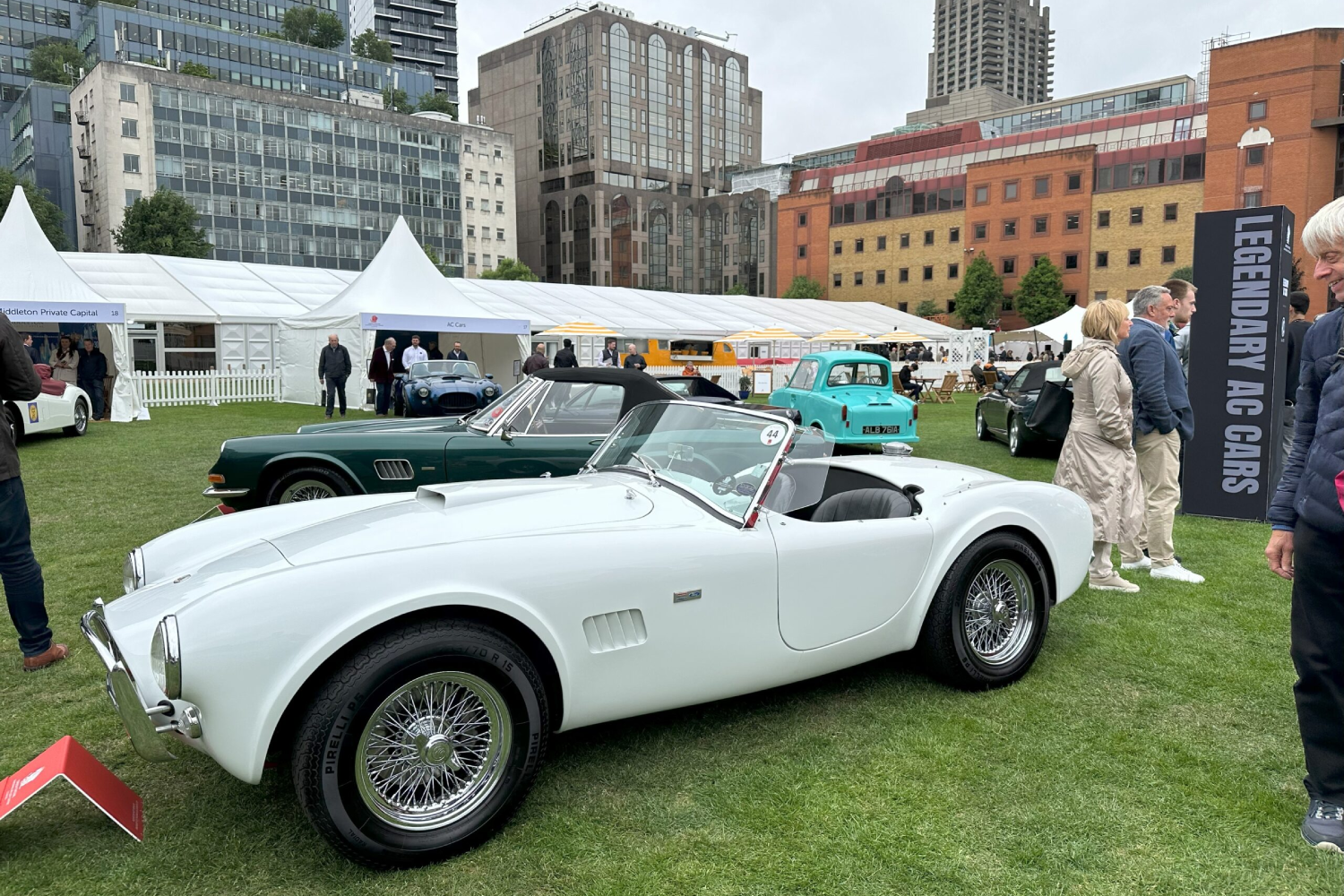
This Cobra 289 is one of only 45 right-hand-drive cars built for the UK – hence why it is known as an AC Cobra, rather than a Shelby Cobra.
Its first owner, Londoner Julian Moulton, used it around town. It was later owned by Willie Green and racing driver Gerry Marshall. John L Hopkins acquired it and had it painted red, but a full restoration with its new owner in 2001 returned it to its original white hue.
In 2013, an engine rebuild prepared it for a new life of long-distance rallies. In the years since it’s been used on the Targa Florio Classic, Modena Cento Ore, Tour Britannia and the Bernina Gran Turismo and in 2013 it became the first Cobra to be shown at Concorso d’Eleganza Villa d’Este.
1967 AC 428 Frua Spyder
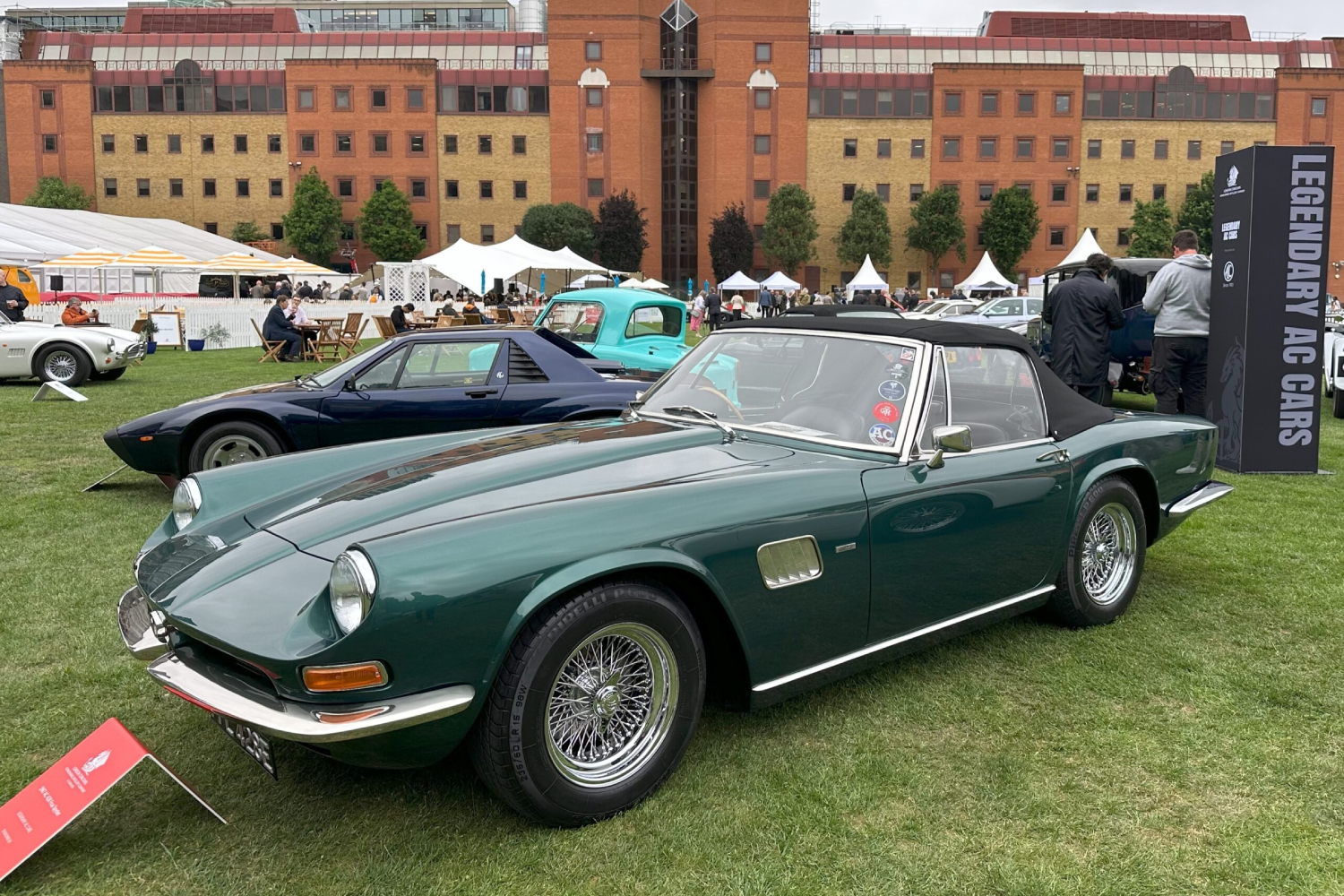
The 428 Frua body was designed in Turin by Pietro Frua, using an extended AC Cobra chassis. Armed with the Cobra’s 427ci Ford V8, it could hit 0-60mph in 5.4 seconds and 145mph.
Chassis no. CF3 was one of three prototypes, but the only car with manual ‘box. It was the AC Cars demonstrator and owned by MD Derek Hurlock for four years. It also featured in a BP advert and was used by Donald Pleasence in the film Arthur? Arthur!
The car went to a US collector, and was restored by Connecticut’s Vantage Motors in 2005. It returned to the UK in 2020 with the current owner, and is tended to by AC Heritage.
1983 AC 3000ME
The origins of the 3000ME project are based in Lola. Staffers Peter Bohanna and Robin Stables worked on a mid-engined, two-seater sports car called the Diablo in their spare time, and in 1972 it appeared at the London Motor Show.
AC bought the project, and developed it into the 3000ME; 104 were built over ten years. Its 138bhp 3.0-litre Ford Essex V6 meant it could hit 60mph in 8.5sec.
This car, the penultimate example built, is owned by Peter Bohanna’s son. It has been fully restored by specialists around the UK, and the work has had plenty of support from the AC 3000ME owners’ club, in particular lan Winter.
1927 AC Royal Saloon
As with many luxury car brands, AC struggled in the wake of the 1929 economic crash. Its new owners had a plan to revitalise the brand with quality bespoke models.
The Royal used AC’s smooth and reliable 2.0-litre straight-six and elegant bodies from coachbuilders such as Whittingham & Mitchel and Mulliner. The interior was the height of luxury, with Connolly leather, deep-pile carpets and polished mahogany or walnut dashboards.
Fewer than 100 would roll out of the AC factory between 1932 and 1940.
The only example of this type of body left, this car’s coachbuilder is unknown. It was acquired by the owner in 1987, and following a two-year restoration it has been in regular use.
1962 AC 2.6 Ruddspeed Ace
It was racing driver and tuner Ken Rudd who persuaded AC to adopt Ford’s 2.6-litre straight-six in 1961. Only 37 so-engined Aces were built.
Chassis RS 5017 has a stage-five Ruddspeed-tuned engine with a Raymond Mays 12-port aluminium head and triple Weber carbs; it develops 180bhp-plus. With its all-aluminium bodywork, it weighs only 864kg and does 0-60mph in 6.0sec.
It was delivered new in October 1962. After three changes of owner it was sold to Andrew Ross in 1973. From 1978 it lay unused for 21 years until Adrian Hamilton rescued it in 1999 and restored it. The current owner since 2012 did a bare-metal respray in 2015. The car has covered fewer than 27,000 miles.
1967 AC Acedes Mk15 (Model 67)
AC may be best known for nimble roadsters and the thunderous Cobra, but the firm built ‘invalid carriages’, too. The Model 67 was an interim model between the old aluminium-bodied Model 57 and the better-known Model 70. It used the Villiers engine and running gear from the Model 57, but had the more modern AC-designed glassfibre body. The Model 70 used the same shape (but with wheelarches), yet with a much-improved Steyr-Puch 493cc engine. Although visually similar, the Models 67 and 70 are very different underneath. This AC Acedes Mk15/ Model 67 is the only road-going example known to exist (of 5928 produced).
The current owner’s father bought it in the 198os, with the aim of fitting a Formula First-sourced Ford CVH engine to “wind up Cobra drivers” on hill climbs and sprints. That project never came to pass, and the car sat in a field from 1997-2011.
A chance comment spurred his son into action-packed odyssey. The project to return the three-wheeler to the road has taken 11 years. The body has been repaired and repainted, and the engine rebuilt by Villiers guru Alf Snell. Most other components have been repaired and replaced, and reassembly was carried out by Rory Stockbridge.
A Legacy of British Motoring Excellence
The London Concours 2025 “Legendary AC Cars” class delivered an unforgettable display. It celebrated a manufacturer with a rich and varied heritage. From elegant pre-war saloons to iconic sports cars, AC built them all. Their vehicles combined innovative engineering with distinctive design. They represented true British automotive spirit.
Visitors to the Honourable Artillery Company gained a deeper appreciation as they saw the evolution of AC Cars. They witnessed the company’s enduring contributions. These vehicles reminded us of a time when British engineering led the world. The exhibition proved a fitting tribute to a truly legendary marque.If you want to see more London Concours content, head over to our YouTube channel to see our London Concours playlist.
Which AC Car Defines Thokieir Legacy For You?
Which AC car from this exceptional lineup do you find most captivating? Do you prefer the early elegance of the Royal Saloon or the raw power of a Cobra? What do you think makes AC Cars so special in the history of British motoring? Share your thoughts and tell us which AC car you would love to add to your collection in the comments below.



Read more on

Do you have a passion for cars? Would you like to join the My Car Heaven team?
Get in touch, we'd love to hear from you.
Find out moreRelated Stories
Advertisement Advertisement
 Advertisement
 Advertisement
 Advertisement