


How the World’s Most Powerful Car Brands Drew Inspiration From the Speed and Spirit of Thoroughbred Racehorses
Horses are a clear inspiration for car brands, and they aren’t even hiding it. After all, some of the biggest car brands like Ferrari and Porsche have horses on their logo, and all of this makes sense.
After all, Thoroughbred racehorses are always associated with power, speed, agility, acceleration, and control, which are also characteristics of car brands. So, it seems like they want to attach themselves to the same adrenaline-rushing feeling as being on a horse.
We stopped relying on horses for transportation years ago but kept using them to describe mechanical power, speed, and temperament. After all, engines are measured in horsepower, but that’s a story for a different time.
Horses are literally everywhere in the automotive world. Ferrari became the Prancing Horse, Porsche placed a rearing horse at the center of its crest, and Ford turned the Mustang into one of the most recognizable performance cars in history.
Bugatti went even further. Ettore Bugatti actually bredThoroughbreds and described his automobiles as pure sang (pure blood).
So, let’s take a closer look at how some of the biggest car brands drew inspiration from horses.
Bugatti Has the Most Genuine Thoroughbred Connection
If we’re looking for a car company that’s truly inspired by Thoroughbred horses, Bugatti is right at the top. Yes, this is a brand that doesn’t have a horse logo, yet the entire DNA of Bugatti is built around Thoroughbred horses.
The company was founded by Ettore Bugatti, and he was a person with a strong passion for Thoroughbred horses.
Bugatti’s own historical archive describes him as an expert on Thoroughbreds who bred horses on his property in Molsheim. He even rode around the factory grounds, welcomed visitors on a horseback, and even designed special door mechanisms that his horses could push open with their noses so he would not have to dismount.
But what’s important is that he often spoke about his cars using the language of bloodstock. Bugatty says Ettore wanted his automobiles to be the “pur-sang” of the automotive world, which is a French expression for “thoroughbred” or “pure blood.” To him, the ideal car was hot-blooded, fast, elegant, and reduced to the essentials for max performance.
This led to the birth of the Bugatti Type 35, introduced in 1924, which became one of history’s great racing cars by combining low weight, balance, and speed.
So, clearly Ettore Bugatti was a big fan of Thoroughbreds and probably horse racing. He let his passion for horses guide his automotive brand. The car brand built its latest $11+ million hypercar called the Bugatti Brouillard, and it was specifically built as a tribute to Ettore Bugatti’s favorite thoroughbred racehorse, named Brouillard.
And if you want to get into horse racing like Ettore, we suggest that you first learn how horse racing betting odds work atTwinSpires.com, then do some research, and find a horse that has the potential to win. Bugatti, as a brand, won’t help you here.
Even Bugatti’s Famous “Horseshoe” Has a Twist
There is an irresistible piece of automotive folklore that Bugatti’s famous grille was designed as a horseshoe because Ettore loved horses.
Lovely story. Not quite true.
Bugatti itself has explained that the original radiator opening was inspired by the oval forms favored by Ettore’s father, Carlo Bugatti, an important designer and furniture maker. The early oval gradually developed a flatter lower edge for engineering reasons, particularly on the Type 35, which caused it to resemble a horseshoe.
The horse association became so appropriate that it stuck anyway.
Bugatti later explicitly described its cars as Thoroughbreds, while the “horseshoe” grille became one of the company’s permanent visual signatures.
Ferrari’s Horse Did Not Come From Racing
Ferrari presents a completely different story.
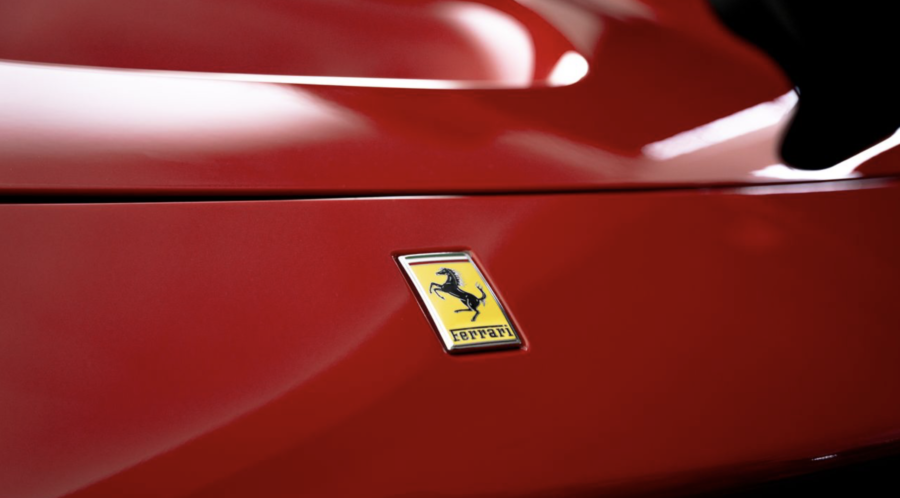
The famous Cavallino Rampante, Prancing Horse, originally belonged to Italian First World War fighter ace Francesco Baracca, who carried the horse emblem on his aircraft.
Ferrari’s official history says Baracca’s family later suggested that Enzo Ferrari use the symbol for good luck. Ferrari added the yellow background representing his hometown of Modena, and the emblem first appeared on Scuderia Ferrari’s Alfa Romeos at the 1932 Spa 24 Hours. Those cars won.
So the original horse was not a Thoroughbred.
It was not even a racing horse.
It came from aviation and military heraldry.
Yet once attached to Ferrari, it took on precisely the qualities that performance-car companies repeatedly seek from equine imagery: energy, motion, pride, and controlled power.
Ferrari itself now describes the Prancing Horse as representing exclusivity, innovation, and cutting-edge sporting performance.
Porsche’s Horse Comes From an Actual Stud Farm
Then we have Porsche, whose horse is neither a racehorse nor a personal symbol of the founder.
It belongs to Stuttgart.
When Porsche created its crest in 1952, designer Franz Xaver Reimspieß placed the rearing horse from Stuttgart’s city seal in the center. Porsche’s official history explains that the city itself grew around a horse-breeding settlement established around the tenth century. The name Stuttgart derives from Stuotgarten, essentially referring to a stud farm or stud garden.
So, every Porsche carries a small piece of medieval horse-breeding history.
Ford Mustang Chose the Horse for Freedom, Not Racing
The Ford Mustang gives us another variation.
Even Ford acknowledges that stories differ about exactly why the Mustang name was chosen, with explanations involving both North America’s wild mustang horses and the P-51 Mustang fighter aircraft. What is much clearer is how Ford chose to represent the car visually.
Designer Phil Clark developed the famous galloping pony emblem. And Ford’s own historical account quotes Lee Iacocca is making an important distinction:
The Mustang represented a wild horse, not a domesticated racehorse.
Ford wanted the car to communicate independence, youth, and open-road freedom rather than pedigree and controlled competition. Company histories have repeatedly described the Mustang emblem as a wild horse running free, intentionally reinforcing the rebellious image of the car.
So, as you can see, many car brands take inspiration from horses, and that’s expected. After all, horses are beautiful creatures, with elegant curves, and carry deep symbolism, and yet they possess incredible power.


Read more on
MyCarHeaven are on Instagram. Go check us out and do follow us.
Go visit the MyCarHeaven Instagram page. We post regular quality content, predominantly focused on classic cars, supercars, hypercars and car shows. We also feature all our competitions here, where you will have the chance IF YOU FOLLOW US and you follow the competition entry criteria, you could be in with a chance of winning tickets to the best UK car shows, and other automotive stuff.
Go to the MyCarHeaven Instagram account here. Advertisement
 Advertisement
 Advertisement
 Advertisement