



Keyless Car Theft in 2026: The Most-Targeted Cars & How to Protect Yours
Keyless car theft in 2026: which cars are targeted, why relay attacks work, and practical steps to close the Relay Gap at home.
Smart Convenience Is the Security Problem
Keyless theft often begins with an ordinary storage choice, not a dramatic break-in. In 2026, the key left on a hallway table can matter more than the lock on the car door. Doorbell camera footage shared by Sky News showed two men unlocking and driving away in under a minute, using nothing more than a pair of cheap relay devices on an ordinary doorstep. No broken glass. no forced entry and no frantic alarm. Just a signal they had no right to reach.
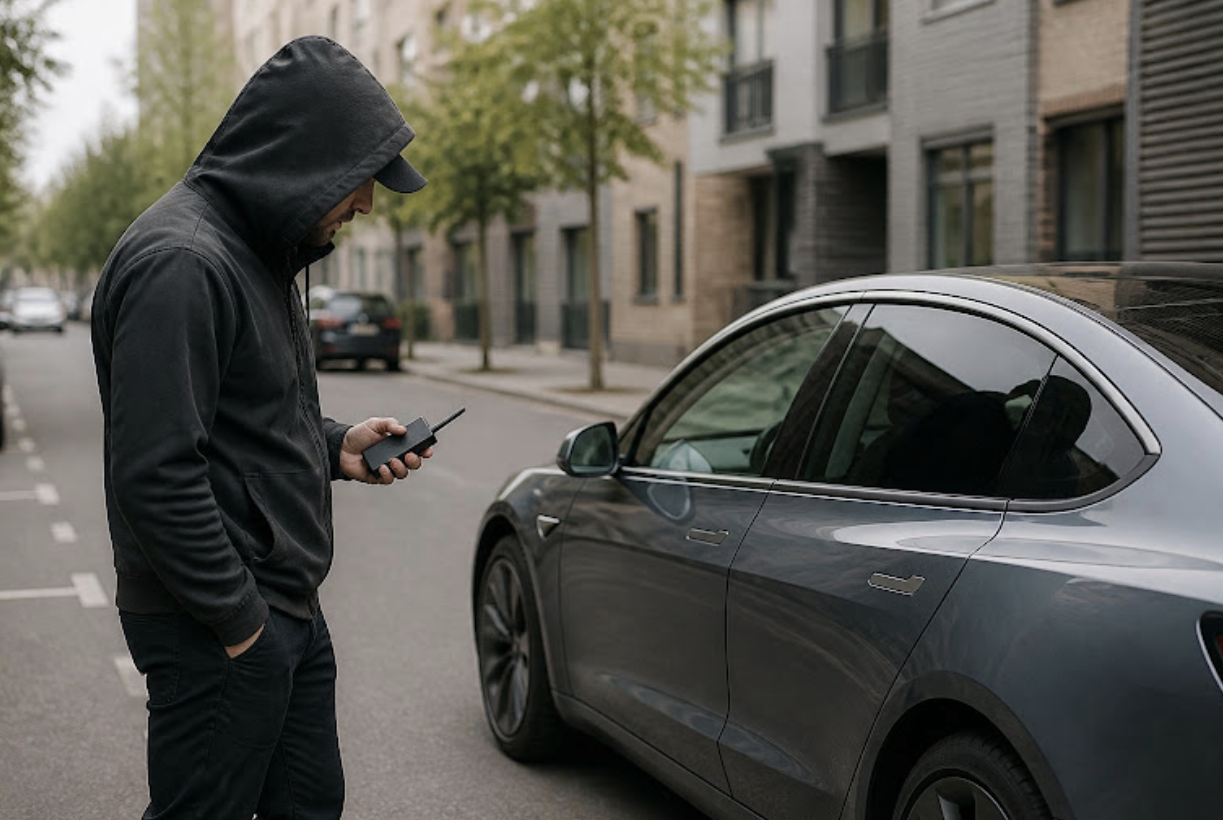
More technology does not automatically mean more security. In many cases, it simply moves the weak point from the lock barrel to the hallway table.
Passive radio systems make your car effortless to unlock. However, thieves have learned to exploit these systems.
Manufacturers designed them for convenience, not insecurity. However, convenience and strong verification often work against each other.
A vehicle trusts a nearby signal almost instantly. Therefore, security depends on whether that signal is genuinely nearby.
A better way to think about keyless car theft is as a permission problem. The thief is not trying to defeat your whole car. They are trying to borrow your key’s presence for long enough to open it, start it, and leave before anyone has reason to look outside.
In 2026, the highest relay-theft risk falls on older high-spec compact SUVs, unpatched premium saloons, and popular export-prone hatchbacks. The quickest wins are a tested Faraday pouch, keeping keys well away from external walls, and a visible steering lock. This article draws on Thatcham Research and NPCC vehicle crime findings to show which cars are most commonly targeted, why they are attractive, and what actually works to keep yours on the driveway.
Thieves chase convenience gaps, not badge prestige. If a car can be started from outside a property, it will be targeted, regardless of price or postcode. The useful question is not, is my car expensive enough to steal? It is, can someone make my car believe the key is beside it while I am asleep?
Do this now: check where your keys are sitting. Move them at least a few metres from any external wall and make that a habit every night. The first useful security upgrade is not a device, it is removing the signal from the street.
How Relay Attacks Work and Why the Relay Gap Matters
A relay attack uses two small devices to stretch your key’s signal across a distance, tricking the car into thinking the key is right beside it. The car unlocks. The engine starts. The thieves drive away, often in under 60 seconds, without forcing entry or ever touching your key.
One thief stands near your front door with a signal amplifier; an accomplice waits at the car. The vehicle detects what it reads as a nearby key and obliges. Doorbell cameras have captured this sequence repeatedly, and the method has changed little since it was first widely reported because the underlying design assumption has not changed enough either.
Rolling codes offer no protection here, and neither does encryption. That may sound odd, because owners are often told modern keys are encrypted and therefore safe. The problem is that both defences assume the conversation between key and car is being intercepted, copied, or decoded. A relay attack does something simpler. It extends the live conversation across a greater distance than the manufacturer intended.
Security researchers call this the Relay Gap. It is the vulnerability that appears when a key stays indoors but still broadcasts a usable signal. Passive keyless entry systems respond as soon as the key comes within range. However, that range is not fixed. Walls and building materials reduce the signal, but rarely eliminate it entirely.
Standard driveway parking is particularly exposed. A car parked two metres from the front door may remain within relay range. The owner may never realise the key hangs behind a glazed panel or thin cavity wall. The signal does not stop politely at the door. It leaks, and a relay device captures that leak and amplifies it to the car.
The Relay Gap is not a flaw in any single brand. It is a structural weakness in how passive entry systems were designed. continues to list relay attack as a leading theft method in its vehicle security assessments, consistent with NPCC vehicle crime data across 2023–2026.
The hardware required is cheap and widely available online. That matters because it changes the threat model. This is no longer a niche technique reserved for highly skilled attackers; it is a repeatable routine for anyone prepared to learn which homes and models offer the least resistance.
Look for Faraday pouches that have been independently tested to confirm signal attenuation across the LF 125 kHz (wake/proximity) and UHF 315/433/868 MHz bands used by keyless entry systems. Rely on verified attenuation test results, not marketing claims, as many pouches on sale fail basic independent testing.
A certified Faraday pouch closes the Relay Gap by blocking the signal at source. Place your key inside and it cannot emit anything usable. Choose a product with published, independent attenuation test results for both the LF 125 kHz and UHF bands. Marketing claims alone do not provide sufficient proof. Never buy a pouch simply because it looks technical. Instead, make sure it blocks the frequencies your key actually uses.
Do this: map your home’s relay window by moving your key to different rooms while someone walks the perimeter outside, noting where the car still responds. Store your key in a room that fails to trigger a response, or inside a tested Faraday pouch. Testing feels excessive until it shows that the supposed safe place by the stairs is exactly where the signal is strongest.
Why Driveway and Doorstep Parking Carry the Highest Risk
Relay theft often succeeds because owners underestimate how far the signal travels. Kitchen counters, hall tables, and bedside drawers near street-facing walls are the most common culprits. Thin cavity walls and glazed front doors let signals pass through far more easily than most people expect. Many drivers don’t realise the difference between storing a key in a concrete-floored garage and leaving it in an open-plan hallway a few metres closer to the street until they test the signal for themselves.
Internal rooms with any kind of line-of-sight path toward the street may still fall within relay range. Distance feels reassuring. It rarely is. The only reliable way to understand your home’s exposure is to test it, not assume it. This becomes obvious once you compare layouts: a Victorian hallway, a modern glazed porch, and an open-plan kitchen all create different signal behaviour.
Move keys at least three to four metres from the primary external wall, or into a Faraday enclosure, every time you arrive home.
A Faraday pouch and deliberate key placement work best in combination. Distance reduces signal reach; shielding eliminates it. Together they close the Relay Gap far more reliably than either measure alone. The practical cost is convenience. You lose the tiny luxury of dropping keys in the same bowl by the door, but you remove the easiest path into the car.
Where people usually struggle is consistency, not knowledge. The pouch works only if the key is inside it. A steering lock works only if it is fitted. Moving the key to the back of the house works only if everyone in the household follows the same routine. Car security often fails at the most ordinary moment, when someone comes home late, drops the key near the door, and assumes one night will not matter.
Do this: store your key in a tested Faraday pouch in a room at the back of the house, away from street-facing walls, every time you come home. If you park on a driveway, treat this as non-negotiable. The routine should be boring enough that you stop thinking about it.
The Most-Targeted Cars for Keyless Theft in 2026
Relay theft in 2026 clusters around a recognisable profile: older high-specification models with passive keyless entry and unpatched ECUs. The highest-risk vehicles are not necessarily the most expensive. They are simply the quickest to unlock and drive away, and that calculation drives the selection choices of organised theft networks operating across the UK.
It is easy to assume thieves mainly want the flashiest car on the road. Often, they want the car that combines demand with predictability. A popular model has more parts value, more buyer familiarity, and more examples parked in the same way outside similar homes. Rarity can sometimes protect a car; ubiquity can make it efficient to target.
and both point in the same direction. Doorbell-camera footage from multiple incidents shows thieves unlocking and pulling away in under a minute, reflecting targeted vehicle selection by criminal networks who know exactly which models offer the least resistance.
Chart based on NPCC/Thatcham archetype vulnerability. Model-level counts are not publicly available at time of writing. Ranking reflects reported theft incidents restricted to models with passive keyless entry. Source: NPCC vehicle crime dataset, 2023–2026 / Thatcham Research, Vehicle Security Ratings 2026.
Alt: Bar chart showing the most-targeted vehicle archetypes for keyless relay theft in the UK, 2026, based on NPCC and Thatcham Research data.
Based on published theft pattern data, the four archetypes most vulnerable to relay attack are:
- Older high-spec compact SUVs (2016–2020) with factory passive entry. The low-energy key signal broadcasts across a wide area, making amplification straightforward. High export demand to Eastern Europe and West Africa keeps resale attractive to organised theft networks. Owners often assume the age of the car lowers the risk, but for thieves an older system with a known weakness can be more attractive than a newer car with better distance-checking.
- Premium saloons (2016–2019) with unpatched ECUs. Firmware on many of these models has not been updated in years, leaving CAN-bus injection and key cloning pathways open once entry is gained. Parts demand is high and resale channels are well established. The overlooked weakness here is not luxury, it is maintenance history: a car can look immaculate and still be years behind on security updates.
- Popular volume hatchbacks exported to European and African markets (2017–2021). High UK prevalence increases opportunity. Many carry passive entry as standard, and the export value of complete vehicles or stripped parts keeps criminal demand steady. These cars are easy to overlook because they do not feel like trophy targets, yet that ordinariness is exactly what makes them useful to a thief.
- Mid-range crossovers with Bluetooth-proximity unlocking and no UWB upgrade path (2018–2022). Bluetooth has a longer effective range than UWB time-of-flight systems, which widens the relay window considerably. UWB is significantly harder to spoof because it measures precise physical distance between key and car, rather than simply detecting signal presence. Many manufacturers have not issued firmware patches for these variants.
Older high-specification models without recent firmware updates are often the easiest targets for thieves, not because of their price, but because they are the quickest to unlock and move.
Four factors drive selection across all archetypes: export and parts demand, high UK road prevalence, passive entry enabled by default, and firmware that has not been updated in years. Speed and minimal resistance matter far more to thieves than badge prestige. A car becomes attractive when the reward is predictable and the friction is low.
That does not mean every car in these groups is equally vulnerable. If you keep your vehicle’s software up to date, store your keys securely, and use visible physical deterrents, you make it far less appealing to thieves than the same model left unprotected on a predictable driveway. Treat the “most-targeted” label as a prompt to improve your vehicle’s security, not as a sign that theft is inevitable.
Do this: check your manufacturer’s website or contact your dealer for any outstanding security advisories or firmware updates. Have your chassis number ready and request written confirmation of any patches applied to your specific vehicle. Model-year advice is useful, but VIN-level confirmation is better.
Physical & Digital Defences to Protect Your Car in 2026
UWB (Ultra-Wideband) keys work by measuring the precise time it takes for a signal to travel between the key and the car. This time-of-flight calculation lets the vehicle confirm the key is genuinely nearby, rather than being amplified from inside your home. Because relay attacks depend on fooling that distance check, UWB makes the technique significantly harder to pull off. Availability varies by manufacturer and model year, so it is worth asking at your next service whether your vehicle supports a UWB upgrade.
It sounds logical to chase the most advanced solution first, but most people should start with the simplest weakness. Where UWB is not yet available, two simpler options exist. First, disable passive entry in your vehicle’s settings entirely. Second, switch to a motion-activated key that goes to sleep when stationary, cutting its signal off automatically. Both options cost nothing and close a genuine vulnerability without any specialist hardware. The compromise is obvious: you may need to press a button again. That is a small inconvenience compared with giving the car permission to unlock itself whenever a signal appears.
Do this: check your vehicle settings app or owner’s manual today and confirm whether passive entry can be disabled. If it can, turn it off. If several people drive the car, make sure the setting has not been re-enabled by another profile or after a software update.
Consider a hardened wheel or steering lock alongside a non-broadcast immobiliser. These add genuine time and effort to any theft attempt, and many opportunistic thieves will simply move on.
If you’ve lost access to a key, need a replacement programmed, or want professional advice on securing a vulnerable keyless vehicle, an automotive locksmith specialising in modern key programming and vehicle security can assess the best options for your model.
For most owners, the highest-impact starting point costs almost nothing. A quality Faraday pouch with independently verified laboratory results blocks the easiest relay theft method. Store it well away from external walls for the best protection. Many pouches sold in supermarkets and forecourts provide no verified attenuation data. Without published test results, you cannot confirm the level of protection they provide. Spend a little more on products with independently verified laboratory results. Combine a tested Faraday pouch with careful key storage and a visible steering lock. Together, these simple measures deter the most common opportunistic theft attempts without specialist installation.
For higher-risk situations, a second layer is worth adding. A non-broadcast immobiliser, one that requires a driver PIN via existing controls rather than advertising its presence, makes silent bypass considerably harder. An OBD port lock is inexpensive and blocks post-theft key cloning or ECU reprogramming. If your insurer requires it, or your vehicle sits at predictable on-street locations, a aids recovery and often satisfies S5/S7 insurer requirements. Use a certified installer for any of these to avoid warranty and insurance complications.
UWB-equipped vehicles perform noticeably better against relay attack tools in independent testing, though older UWB implementations, particularly on vehicles from 2021–2022, are less consistent than more recent versions. The spec sheet suggests protection; the real-world result depends heavily on firmware version, and UWB handling differs meaningfully between manufacturers. OBD port locks are genuinely effective, but check fitment before buying, as some vehicles position the port in an awkward recess where cheaper lock housings do not seat properly. A steering lock only works if you use it every single time; kept on the back seat after the first week, it does nothing. Store it in the footwell instead, so reaching for it becomes automatic before you leave the car.
The practical order matters. Start by stopping the key from broadcasting into the street. Then make the car visibly slower to steal. Then close digital routes such as OBD access, firmware gaps, and passive entry settings. Many well-intentioned upgrades fail because expensive equipment sits on top of an unchanged routine.
Do this: pair a lab-tested Faraday pouch with at least one physical deterrent, such as a steering lock or OBD port lock, before relying on either measure alone. The strongest setup is not the cleverest one, it is the one you will actually use every day.
Insurance, Compliance and Resale
Many owners do not realise that insurers increasingly name specific conditions for high-value or technology-heavy vehicles, whether that is Thatcham S5 or S7 tracker approvals or particular immobiliser standards. Failing to meet a named condition can affect a claim, regardless of whatever else you have fitted, and that gap in cover rarely becomes apparent until after something goes wrong.
This is where security becomes paperwork as much as hardware. Before making any changes, contact your insurer directly. Ask whether your policy specifies Thatcham-approved tracker categories or immobiliser standards for your vehicle, and request written confirmation. When speaking with your dealer, ask whether your VIN has received all relevant security, ECU, and CAN-bus patches, when they were applied, and for a written record. Keep both confirmations with your vehicle paperwork.
Documented manufacturer updates and installer certificates also improve outcomes when filing a claim. Aftermarket installations can affect warranty and resale value unless they are certified, reversible, and fully receipted. Buyers often value a recognised tracker or immobiliser, but mystery wiring, missing certificates, or a device that sellers cannot explain during the sale are far less likely to impress them.
The commercial risk is that the cheapest installer is not always the cheapest decision. Poorly fitted security equipment can create electrical faults, warranty disputes, and insurance questions. For owners of higher-risk cars, the paperwork trail is part of the protection because it proves that the security was not improvised.
Do this: call your insurer, ask the questions above, and file the written responses with your service history before fitting any aftermarket security device. Verbal reassurance is easy to give and hard to rely on.
What Realistic Protection Looks Like
Layered defences deter and delay. They can meaningfully reduce your exposure, but no combination of measures eliminates risk entirely. The realistic goal is to make an attack unattractive and time-consuming, not impossible. In vehicle security, perfection is usually the wrong target; friction is the useful one.
The pattern usually appears when an owner adds one impressive measure, then lets the routine slip. Behavioural slippage, missed firmware updates, and complacency after adding a single measure are the common failure modes. With a UWB key, a physical immobiliser, and an OBD port lock in place, a vehicle shifts from easy target to low priority for all but the most determined attacker. Opportunistic relay theft depends on convenience gaps, and these measures close most of them.
Start with your risk profile. If your car matches a high-risk archetype, parks predictably on-street, or appears in recent NPCC vehicle crime or outputs, professional hardening is worth the investment. For most owners, the cheap behavioural fixes deliver the greatest return per pound spent. Distancing keys from external walls and using a tested Faraday pouch costs almost nothing and works.
For context on typical UK costs: a tested Faraday pouch runs roughly £10–£40, an OBD port lock around £20–£60, a hardened steering or wheel lock £40–£150, and a Thatcham S5/S7-approved tracker £200–£500 plus an annual subscription. Treat these as order-of-magnitude estimates, since prices vary by model and installer.
Small changes to routine, done consistently, outperform expensive kit installed once and forgotten. That is the uncomfortable lesson of keyless car theft in 2026: the weakest point is often not the car, but the moment after you get home, when convenience quietly wins again.
If your car is newer, UWB-equipped, garaged, and backed by current firmware, you may not need an elaborate aftermarket setup. If it is an older passive-entry SUV, saloon, hatchback, or crossover parked near the street every night, treat layered protection as basic ownership, not paranoia. Remove the key signal from the doorstep tonight, then confirm the car’s digital and insurance position this week.
About the reviewer
Independent automotive security analyst. Tracking vehicle theft trends and manufacturer countermeasures since 2018. Not affiliated with any insurer, tracker manufacturer, or security product supplier covered in this article.
Side-by-side comparison of relay attack vulnerability ratings across the most-targeted models in 2026, showing which have UWB, factory immobiliser, and OBD protection as standard. Chart based on NPCC vehicle crime dataset (2023–2026) and Thatcham Research vehicle security ratings. Model-level counts are not publicly available; ranking reflects reported theft incidents restricted to models with passive keyless entry vulnerability.


Read more on
MyCarHeaven are on Instagram. Go check us out and do follow us.
Go visit the MyCarHeaven Instagram page. We post regular quality content, predominantly focused on classic cars, supercars, hypercars and car shows. We also feature all our competitions here, where you will have the chance IF YOU FOLLOW US and you follow the competition entry criteria, you could be in with a chance of winning tickets to the best UK car shows, and other automotive stuff.
Go to the MyCarHeaven Instagram account here. Advertisement
 Advertisement
 Advertisement
 Advertisement